
Charlotte's 2026 Economic Paradox: Rising Foreclosures Amid Corporate Growth
Charlotte's 2026 economy is telling two very different stories. Foreclosure activity is rising across parts of the metro while major corporations continue investing hundreds of millions of dollars and creating new jobs. This explainer looks at the data behind Charlotte's economic paradox and what it could mean for the housing market.
Charlotte's economy in 2026 presents a complicated picture. While corporate investment and job announcements point to continued economic confidence in the region, some homeowners are facing increasing financial pressure.
In this explainer, we look at the contrast between rising foreclosure activity and continued corporate expansion across the Charlotte Metro. We also examine housing prices, inventory, market timing, and what these competing trends could mean for buyers, sellers, and homeowners.
The goal is not to label the market as simply "good" or "bad." Instead, this video explores why different parts of the Charlotte region can experience very different economic realities at the same time.
Watch the Full Video Here
Watch the full explainer to hear the complete breakdown of Charlotte's 2026 economic trends and the questions these numbers raise for the future of the region.
Video Transcript
Welcome to the Explainer. Today, we're breaking down a really massive economic paradox hidden right inside the latest 2026 data for the Charlotte Metro region. Now, if you follow regional economics, you know the drill, right? Usually, numbers trend together. Either a rising tide lifts all boats or a receding one lowers them all at once. But Charlotte's tide, it's somehow doing both at the exact same time. On one hand, we're seeing some really intense localized financial pain for everyday homeowners. But on the other hand, we're witnessing an absolute explosion of corporate growth and capital investment. It's a true split-screen reality, and we're going to untangle exactly what's going on by looking straight at the data.
All right, let's jump right in with a number that is, honestly, pretty staggering: 71%. Foreclosure filings in the Charlotte Metro area jumped 71% in the first half of 2026 compared to the exact same period last year. Just think about that for a second. After a relatively quiet stretch over the last few years, foreclosure activity has roared back with serious force. According to the data tracked by Adam, a property information company, one in every 500 homes across this 10-county metro region faced some sort of legal action between January and June. We're talking default notices, auction schedules, bank seizures, the whole shebang. It's a massive spike, and it's a huge signal that homeowners in the area are struggling significantly more right now than they were just 12 months ago.
But here's the thing. This distress isn't just sprinkled evenly across the map. It's intensely concentrated. While the broader metro area sits at that one in 500 foreclosure rate, Chester County is suffering a completely different reality right now. They actually topped the list as the hardest-hit county in the entire study, with one in every 222 homes facing legal action. [snorts] To put that into perspective, the source data points out that literally no other county in the 10-county analysis even came close to matching Chester's concentration. So, Chester is essentially pulling the regional average way up, while other counties with minimal activity are bringing it down.
Now, you might be wondering, with foreclosures spiking like that, the housing market must be in an absolute free fall, right? Plummeting prices, massive oversupply? Well, remember, we are talking about an economic paradox today. So, to understand what's actually happening with buyers and sellers, let's look at the latest numbers provided by the Canopy Realtor Association.
The data from May 2026 reveals a much, much more complicated reality. Because here is where things get really weird. Despite the severe distress we just saw in places like Chester County, the median sales price across the region is actually still creeping up. Just look at the facts from May 2026. The median sales price increased by 1.2% year-over-year to nearly $410,000. And at the exact same time, the inventory, or the months supply of homes for sale, is slowly building up, increasing 9.1% to 3.6 months of supply.
So, you have this incredibly strange situation where homes are getting slightly more expensive, even as more of them sit on the market, and even as a growing segment of homeowners are losing their properties entirely. The crucial takeaway here is that the real estate market is definitely shifting gears. It's downshifting. Homes are taking increasingly longer to move from listed to closed. The list to close metric, which tracks the total number of days from the initial listing date to the final sold date, bumped up to 90 days in May 2026, compared to 88 days the previous year.
Now, sure, two days might seem like a really small bump on its own, but when you combine it with the rising inventory and those mounting foreclosures, it paints a very clear picture of a sluggish, grinding market. For sellers, that means more friction, more anxiety, and just taking longer to finally cross the finish line.
So, with foreclosures shooting up and a sluggish housing market that's taking longer to close deals, you've got to ask yourself, is the entire regional economy actually on a downward slide? I mean, if families are struggling to keep their homes, you would logically expect businesses in the area to be pulling back, freezing their hiring, maybe bracing for a recession, right?
Well, actually no. This is where our paradox completely flips the script. When we zoom out to look at the broader corporate landscape, the story changes entirely. Checking out the Q1 2026 growth report from the Charlotte Regional Business Alliance, which tracks capital investments and job announcements across the exact same regional footprint, gives us a totally different vibe.
The findings here stand in stark, absolute contrast to the household distress we were just unpacking. Because instead of an economic slump, the region just secured a massive $434.6 million in new capital investment for the first quarter alone. Let that sink in. That is nearly half a billion dollars of corporate money flowing directly into the regional economy in just 3 months.
And along with that massive injection of cash comes 1,068 newly announced jobs spread across 12 different projects. It's literally the definition of a corporate boom, and it's happening right in the backyard of a mounting housing crisis.
To put some concrete examples to this, this incredible boom is being driven by massive, heavy-hitting new facilities springing up across the map. Just look at these top-line projects. We're seeing a brand new Costco distribution center heading to York County, which represents a staggering $240.3 million investment and brings 165 new jobs. Right alongside that, there's a new Cyclic Materials Manufacturing Plant in Chesterfield, bringing in $82 million and 90 jobs.
These aren't small moves. They're multi-million dollar commitments from major corporations, signaling immense, long-term confidence in the region's economic future.
So, we are quite literally witnessing a tale of two economies. It's a stunning split-screen reality. You've got a 71% jump in foreclosures over on one side and a roaring corporate environment pumping nearly half a billion dollars into the exact same region on the other. It's a wild divergence between macro level corporate success and micro level household struggle.
Which brings us to the final vital question you should take away from this explainer today. What happens next to a community that is caught perfectly between a corporate boom and a housing crisis? As these huge new facilities open their doors and start hiring workers, is that new wage growth going to be enough to rescue this sluggish housing market and stop the foreclosure surge? Or is the region just going to continue to split, creating this widening gap between thriving corporate centers and struggling neighborhoods?
The data leaves us at an incredible crossroads. And it is a trend that anyone following the economy has to keep a really close eye on. Thanks so much for joining me today to untangle this economic paradox.
Source note: The article above indexes the transcript exactly as provided. The statistics and source references mentioned in the transcript have not been independently verified here.

Living in Ballantyne, NC: Is This Charlotte Suburb the Right Fit for You?
Ballantyne is one of Charlotte's most sought after suburbs, but it isn't the perfect fit for everyone. In this video, we explain who thrives in Ballantyne, what daily life is really like, and the lifestyle, commute, HOA, and community factors every relocating buyer should consider.
Ballantyne has become one of the most popular places to live in the Charlotte metro area, especially for relocating professionals and families. With newer neighborhoods, excellent conveniences, highly regarded schools, and a polished suburban feel, it's easy to understand why so many buyers put Ballantyne at the top of their list.
But while Ballantyne offers an incredible quality of life for many people, it is not the perfect match for every lifestyle. Before you buy a home here, it's important to understand what daily life actually feels like, how commuting can affect your routine, and whether Ballantyne aligns with your long term goals.
Watch Full Video Here
Video Transcript
All right, let's talk today about who Ballantyne is really built for.
Ballantyne is honestly built for people who want convenience without feeling like they're in the middle of all the Charlotte chaos.
This area attracts a lot of corporate relocations because you've got polished neighborhoods, strong schools, newer homes, and easy access to office campuses.
Families love it because everything feels planned out from the parks to the sidewalks, shopping, schools.
It's all very predictable and in a good way.
Remote workers do really well here, too, because you can basically live your entire life within a 10-minute radius.
If you are somebody who wants night life, walkability, and constant energy, Ballantyne may feel a little too polished or suburban.
This is more of a lifestyle suburb than an entertainment suburb.
The bubble feeling, insular, community verse, connected suburb.
One thing people don't realize until they move here is Ballantyne can feel like its own little world.
Pros and cons to that.
A lot of residents honestly don't leave South Charlotte much during the week because everything they need is already here.
That can either feel super convenient or kind of isolating dependent on your personality.
So, some buyers love the clean, organized, master planned, beautiful feel.
Others eventually start saying it feels too repetitive because many neighborhoods, shopping centers, and roads start blending together.
You are connected to Charlotte technically, but emotionally Ballantyne feels separate from the city.
If you thrive on variety and city energy, that bubble can hit you fast.
Access to work corridors and how commute shapes daily life here.
Your experience in Ballantyne changes dramatically based on where you work.
If you work in Ballantyne or South Charlotte, Fort Mill, or even parts of South Carolina, life here is incredibly easy.
But if you commute uptown every single day, especially during peak traffic, or even further north, you are going to feel it.
People moving from out of state sometimes look at mileage instead of drive time, and that's a huge mistake in Charlotte.
Certain roads around Ballantyne can bottleneck quickly during school hours and rush hour.
The people who love Ballantyne long term usually have a lifestyle where most of their daily routine stays on that side of town.
Commute compatibility is a huge deal here.
So, what the retail and dining scene actually looks like day to day is very convenient retail, not necessarily super unique retail.
You've got almost every major store, grocery option, fitness studio, and service business you could need.
Errands are simple.
Dining is improving a lot, especially compared to maybe 10 years ago.
You'll find upscale casual restaurants, brunch spots, wine bars, and polished chains.
But if you are expecting tons of local artsy districts, or hidden hole in the wall neighborhoods, that's not really Ballantyne's identity.
The lifestyle here is more practical and polished than trendy and eclectic.
For a lot of families, that's exactly why they love it.
HOA culture and what you expect as a new resident is something that not too many people talk about.
Now, HOA is heavy in Ballantyne.
A lot of neighborhoods here are very well maintained because the HOA standards are strong.
That means beautiful entrances, consistent landscaping, clean streets, and solid curb appeal.
But it also means there are rules.
Depending on the neighborhood, you may have regulations on parking, exterior changes, fencing, rentals, even trash cans.
For some buyers, that structure creates peace of mind.
For others, it can feel restrictive pretty quickly.
Before buying in Ballantyne, I always tell people, don't fall in love with the house.
Read the HOA documents, too.
You want to go in eyes wide open.
Some buyers love it, and others feel isolated within a year.
The people who thrive in Ballantyne usually want stability, convenience, and predictability.
Life feels efficient here.
Parents especially love how family oriented the area feels, but buyers who are highly social, crave night life, or want strong community interaction sometimes struggle after the excitement of moving wears off.
A lot of neighborhoods here are incredibly beautiful, but they can also feel private and somewhat disconnected socially.
You may know your neighbors casually, but this isn't always the kind of area where everybody's constantly outside interacting.
Some people describe Ballantyne as peaceful, others describe it as sterile.
Neither one is wrong.
It really comes down to personality and lifestyle fit.
That's why we always say Ballantyne is a fantastic area for the right buyer, but it's not automatically the right fit for everybody, just like all other cities around Charlotte.

The Real Cost of Living in Charlotte: What Online Calculators Don't Tell You
Online cost of living calculators can be helpful, but they rarely reflect what life in Charlotte actually costs. In this video, we explain the hidden expenses many relocating buyers overlook, including utilities, property taxes, commuting, lifestyle changes, and why planning beyond your monthly mortgage payment is so important.
If you're planning a move to Charlotte, chances are you've already searched for a cost of living calculator. While those tools can provide a general estimate, they rarely capture what your monthly expenses will actually look like once you're living here.
The reality is that everyone's lifestyle is different. From commuting habits and grocery shopping to utilities and local taxes, your real cost of living depends on much more than averages.
Watch Full Video Here
Video Transcript (Exact Words)
All right, let's talk real life for a second. Let's talk about the cost of living and those fun online cost of living calculators. So, they may look nice, they feel official, but they are not telling the full story. They're pulling in oftent time averages, broad data, assumptions, not your lifestyle, your habits, and definitely not how we spend our money on a daily basis.
So they don't factor in how you we may eat out, what kind of groceries are being bought, commuting to and from sporting events for the kids or maybe the local gym or child care memberships or what your normal routine may look like.
So what I see with buyers relocating all the time is that your monthly costs hit different once you're actually living here. So, your mortgage might look great on paper, but then you've got property taxes, insurance, maybe special assessments in the neighborhood or utilities that fluctuate with different types of seasons and weather.
In some areas, maybe your electric bill jumps high in the summer or your heating cost spikes in the winter. So, those things do catch people offguard.
Then there's gas, commuting distance, tolls if applicable, depending on where you land, and it all can add up quickly.
So, here's one no one talks about enough, and that's lifestyle inflation after you move to a new area.
What is that, you ask?
You are super excited. You want to try all the new things. You want to try the new restaurants. You want to explore different areas and places and maybe join a gym, get involved with the community, etc. And suddenly your spending creeps up, not because you're careless, but because you're enjoying your new area and where you live.
That's real life and things that online calculators didn't account for.
There is almost always a big adjustment period. So, give yourself that grace period. The first 3 to maybe 6 months, you're figuring out where to shop, where to save, what's worth it, what's not. You're dialing in your new normal, and that takes time.
We always tell buyers, don't panic early on if things feel off. It's just part of that transition, and it's a natural transition.
Now, let's zoom out and think long term because that's where smart buyers win.
Don't just ask, "Can I afford this today? How does this fit two, three, five years down the road?"
Think about maybe your future income growth and career stability. Also, future expenses, maybe even investing or upgrading later.
The goal isn't just to make the move. We want you to feel comfortable and confident after the move, too.
So the bottom line, numbers online are just a starting point, not the final answer. The real cost of living is personal to each and every one of us. It's behavioral and it's something you want to walk through with someone who understands the local market. Asks you the questions on what your future lifestyle or current lifestyle looks like and how you live in it.
Have a grand day from Grand Allure Home Group.
Charlotte Home Buying Budget Guide: What Different Price Points Can Get You in 2026
What can your budget really buy in Charlotte's housing market? From entry-level homes in the low $300,000s to new construction above $500,000, today's buyers are making important trade-offs between location, size, condition, and monthly affordability. In this video, Grand Allure Home Group explains what to expect at different price ranges and shares practical advice to help buyers make informed decisions in the 2026 Charlotte real estate market.
Buying a home in the Charlotte area is all about balancing your budget with your priorities. Whether you're relocating or purchasing your first home, understanding what different price ranges typically offer can help set realistic expectations before you start touring properties.
In this video, we break down what buyers can generally expect at different price points, the biggest trade-offs buyers are making in today's market, and how factors like location, HOA fees, property taxes, and interest rates all impact affordability.
Watch Full Video Here
Video Transcript
Hey there. So, in the Charlotte market right now, entry-level buyers are typically starting around the low 300s to maybe up towards the mid 400s.
And expectations need to still be realistic at that price point.
That price range does often mean older homes, smaller square footage, maybe even a condo or a townhome instead of a detached single-family home.
And once you move into that range or a little bit higher actually, you start seeing more updated homes, maybe a more ideal location for you and more inventory, too.
So, it's still not considered luxury, but a bit more balanced options.
Five hundred thousand and above is where buyers begin to get into maybe new construction, more desirable suburbs, and homes with upgraded finishes and larger lots that a lot of us love.
Buyers are consistently making trade-offs right now.
So, it's rare to get everything on the wish list.
And the biggest trade-offs I'd say right now that we are seeing is condition versus location.
So buyers choosing maybe that prime area that they love, but maybe more of a fixer-upper or some future sweat equity that you could put into it.
And then other than that, there's a turnkey home that could be purchased farther out and on the outskirts of town.
Another common compromise is sizing.
So opting maybe for less square footage to stay within that budget range in competitive areas.
Some buyers are, you know, giving up things like large yards or even garage space just to stay within the budget and where they want to be.
Location versus size is a major decision point in this market.
So, closer to Uptown or South End or areas like Dilworth and Plaza Midwood, buyers are sacrificing space for that awesome walkability and proximity.
As you move out towards some of the suburbs or areas like Huntersville or Concord or Gastonia, buyers can get significantly more house for the money.
A lot of times more yard for the money and the commute time does become a major factor.
So what you save in price, you may spend in time or gas.
HOA fees are something buyers also underestimate going in.
So townhomes and condos often have higher monthly dues that impact affordability just as much as the purchase price.
Even some single-family neighborhoods around Charlotte, especially newer construction communities, have HOA fees that cover amenities like neighborhood pools, playgrounds, sidewalks, and more.
Those amenities can be great, but they also add to your monthly housing costs.
Property taxes vary by county as well.
Mecklenburg County versus surrounding counties like Cabarrus, Union, and Iredell can make a noticeable difference in your monthly payment.
Market realities right now are also important to understand.
Affordability is still tight even though appreciation has slowed compared to previous years.
We're no longer seeing the same double-digit appreciation in many areas, but interest rates continue to play a major role in what buyers can actually afford.
Remember, your interest rate directly affects your monthly payment.
The monthly payment is often more important than the purchase price alone because that's what determines whether the home comfortably fits your budget.
Inventory has improved slightly, but well-priced homes in desirable locations and good condition are still moving quickly.
We're still seeing multiple offers on many of those properties.
Buyers need to be prepared to act quickly while also remaining strategic.
Overpaying or stretching your budget too far can create unnecessary long-term financial stress.
That's why it's so important to work with an experienced real estate professional who understands negotiation strategies and can help determine whether a property is likely to receive multiple offers.
Right now, the biggest key is aligning expectations early so there are no surprises once you begin touring homes.
Hope this helps, and we also hope you have a grand day from Grand Allure Home Group.
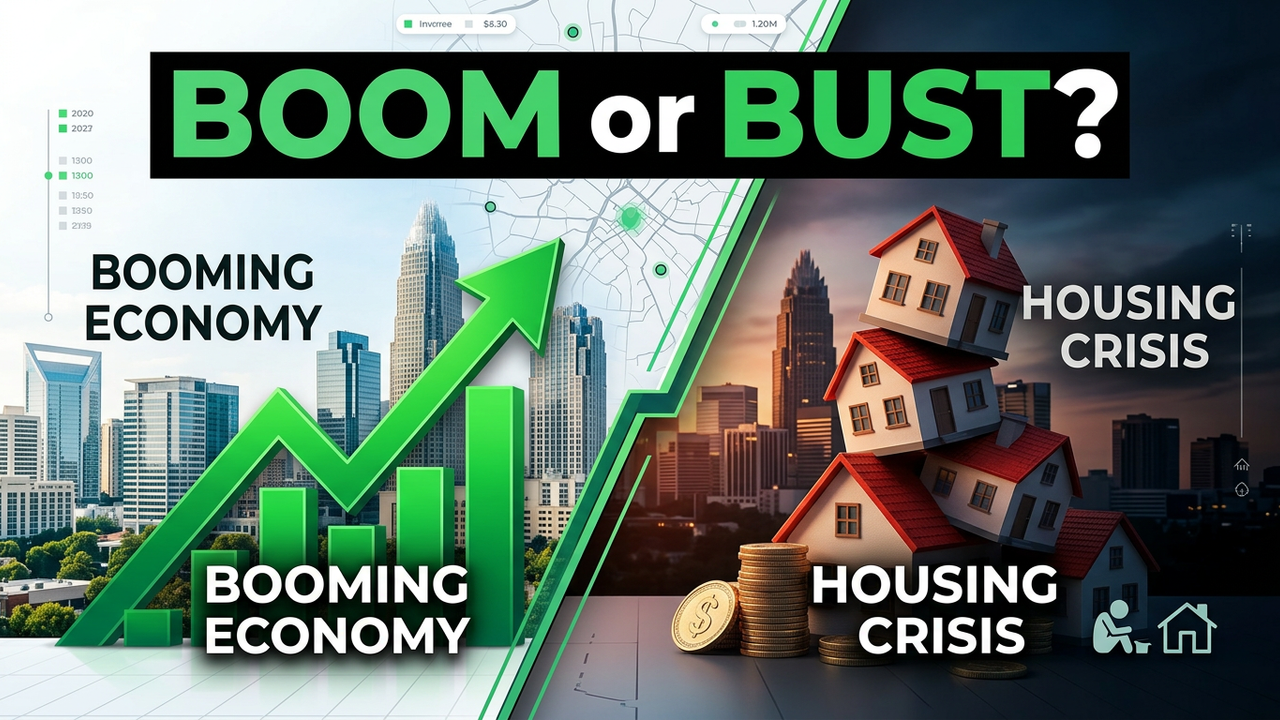
Charlotte's 2026 Housing Market: Record Growth Meets an Affordability Crisis
Charlotte is experiencing one of the strongest economic expansions in the country, but that growth comes with significant housing challenges. In this market update, we examine the forces driving Charlotte's 2026 real estate market, including record job creation, increasing housing inventory, rising ownership costs, and the growing affordability gap. Whether you're buying, selling, investing, or relocating, this explainer breaks down the data shaping the Queen City's future.
Charlotte is one of the fastest-growing cities in the country, adding thousands of jobs, attracting major corporate headquarters, and investing billions into its future. But behind the impressive headlines lies a very different story.
In this video, we break down the economic forces driving Charlotte's rapid expansion, how the housing market is shifting in 2026, the rising costs of homeownership, and why affordability continues to be one of the region's biggest challenges.
Watch the Full Video Here
Video Transcript
All right, let's dive right into this explainer. Today, we're breaking down a massive paradox, the complex contrasting realities of Charlotte's booming economy and its severe housing crisis, looking right at the landscape in 2026. This is a fascinating look at what happens when a city just explodes with record-breaking success on a global stage while simultaneously grappling with the hidden and honestly often painful costs of that exact same growth.
We're literally looking at a tale of two cities here. And what makes this so incredibly compelling is that these two realities, they aren't happening one after the other. They are happening right now at the exact same time on the exact same streets. The wealth generation and the affordability crisis are totally tied together, feeding off one another in this rapid cycle of urban transformation.
Here is how we're going to break this down.
First, Charlotte's record economic boom.
Second, a shifting real estate market.
Third, the hidden ownership costs.
And fourth, the widening affordability gap.
Okay, let's jump straight into section one, Charlotte's record economic boom.
To really wrap our heads around the scale of this, according to the city's economic development reports, Charlotte added nearly 38,000 new jobs in 2025 alone. I mean, 38,000. That is a staggering number. They completely blew past larger peer metropolitan areas across the country.
We aren't just talking about a slow, steady climb here. We are looking at a historic spike in job creation that signals Charlotte's massive competitiveness and long-term resilience.
Adding that many jobs in a single calendar year fundamentally reshapes a local economy. It creates this undeniable gravity. People are packing up and moving from all over the country to fill those roles. And they bring with them new income, new demand for services, and a palpable energy that transforms the city's daily pace.
It's the kind of momentum cities spend decades trying to manufacture. And Charlotte is living it right now.
A huge piece of that puzzle includes massive wins like the iconic automobile manufacturer Scout Motors, who selected the Plaza Midwood neighborhood for its new global headquarters. This move alone is bringing 1,200 new high-paying jobs in one of the state's absolutely biggest recent economic announcements.
It's the exact kind of investment that cements Charlotte's reputation as a total magnet for top tier global brands.
But think about the ripple effects for a second.
Injecting 1,200 high-salary professionals into a single historically vibrant neighborhood. Those workers need places to eat, coffee shops to work from, dry cleaners, the whole shebang. They fuel local businesses for sure, but they also radically shift the demand curve for local housing and commercial real estate.
One single corporate announcement essentially supercharges an entire zip code overnight.
And Charlotte is investing heavily to make sure that growth doesn't just fizzle out.
Mecklenburg County voters actually just approved a 1 cent transit tax that's projected to generate an unbelievable $19.4 billion over 30 years.
That is a massive, massive commitment to the future.
That money is earmarked specifically for rail construction, road improvements, and bus infrastructure.
The city clearly understands that you cannot just add tens of thousands of jobs without fundamentally upgrading how people actually move around.
They are physically building the pathways, the literal steel and concrete to sustain this massive influx of people and businesses for the next half century.
Add in the massive hype of hosting the expanded 2026 FIFA World Cup along with a newly renovated Spectrum Center, which drew nearly 325,000 guests in its reopening month alone, by the way, and it is no wonder the county is seeing $6.4 billion in annual tourism spending.
Tourism alone fuels 38,000 additional jobs in Mecklenburg County.
From corporate headquarters to global sporting events, the economic engine is absolutely roaring.
So, let's move into section two, a shifting real estate market.
By June 2026, buyers are finally seeing a few more options.
Total inventory hit 12,726 active homes, which is the highest level we've seen since November 2025.
Overall housing supply is up 9.2% year over year, and that's largely driven by a massive surge in attached housing.
Townhome inventory is up over 27% and condos are up nearly 18%.
And honestly, this makes perfect sense when you consider the realities of a booming city.
As land costs skyrocket and urban space becomes a premium, builders naturally pivot toward denser options like townhomes and condos to maximize their footprint.
For buyers, this means getting slightly more leverage, more choices, and maybe a little more time to evaluate options compared to that frantic buy-it-sight-unseen pace we had over the last few years.
But because the market remains so fiercely competitive thanks to all those new jobs we just talked about, buyers are making incredible compromises.
Clever Real Estate data shows an astounding 76% of buyers are willing to overlook major red flags just to secure a home.
Listen to this breakdown.
Fifty-seven percent would overlook pest issues.
Forty-nine percent would consider a home with mold.
Forty-five percent would still evaluate a home with structural concerns.
Think about that for a second.
Would you willingly buy a home with known structural damage just to avoid missing out?
People are incredibly desperate to plant their flag in Charlotte's booming soil, pushing aside common sense and long-term risk just to get a piece of the pie.
Which brings us right into section three, the hidden ownership costs.
The traditional focus of home buyers used to be pretty simple.
Lock in a good mortgage rate and you're set.
Today buyers are being heavily squeezed by the new reality, the total cost of ownership.
We are talking about the unavoidable combination of taxes, maintenance, and insurance.
As a city booms, inflation and intense demand drive up property assessments, meaning your property taxes increase.
At the same time, the cost of labor for basic home maintenance rises because local contractors are overwhelmed with demand.
These secondary costs increase alongside property values, fundamentally changing the math on what actually makes a home affordable month after month.
Get a load of this.
According to Pew Research, home insurance costs alone have increased roughly 46% since 2021.
Seventy-one percent of homeowners report that their insurance premiums have gone up, acting as a major hidden barrier to affordability.
It is frustrating for middle-class buyers who save for years, finally gather enough for a down payment, only to find themselves priced out by insurance costs before they even reach the closing table.
When you combine this increase with higher mortgage rates, rising property taxes, and the cost of repairing issues buyers are overlooking, the dream of homeownership quickly becomes much more expensive than expected.
That leads us into section four, the widening affordability gap.
The numbers here are sobering.
According to the 2025 State of Housing Instability and Homelessness report, as redevelopment and gentrification spread across the region, 77% of the low-cost housing available in 2015 had disappeared by 2024.
The focus on building higher-end housing has dramatically reduced affordable housing options for lower-income residents.
Entire neighborhoods have changed, pushing out many of the people who help keep the city running every day.
Half of all renters in Mecklenburg County are now considered cost burdened, meaning they spend more than 30% of their income on housing.
Between 2013 and 2023, cost burdened households increased from about 74,243 to more than 107,000.
The number of severely cost burdened households, those spending more than half of their income on housing, grew from just over 33,600 to nearly 53,900.
For many families, that means making impossible choices between housing, healthcare, food, or other necessities.
For households earning 30% or less of the area's median income, there is currently a shortage of more than 32,600 affordable rental units.
This is the ultimate contradiction of Charlotte's growth.
The city is investing $19.4 billion into transportation infrastructure while still facing a severe shortage of housing for its lowest-income residents.
As a result, homelessness continues to impact thousands of people across the region.
The burden is also not shared equally.
Black residents make up approximately 29% of Mecklenburg County's population but represent 74% of the county's homeless population.
In 2023, approximately 66% of white households were homeowners compared to just 41% of Black households.
The affordability gap continues to widen and disproportionately affects communities that have historically faced greater barriers to homeownership.
Which leaves us with one final question.
As Charlotte builds its future through billions in infrastructure, corporate investment, and global events, how can it ensure that the people who make the city thrive can still afford to live there?
We've explored the remarkable economic growth shaping Charlotte today, but the long-term success of any city is ultimately measured by whether prosperity reaches everyone.
Thank you so much for joining me for this explainer, and I hope this deep dive into the data gave you a much clearer picture of the forces shaping Charlotte in 2026.

Charlotte Traffic Explained: What Relocating Buyers Need to Know Before Moving in 2026
Many people relocating to Charlotte ask the same question: "How bad is the traffic?" The answer depends on where you live, where you work, and when you're traveling. In this guide, we break down Charlotte commute times, major traffic corridors, public transportation options, and how location choices can dramatically impact your daily routine.
If you're planning a move to Charlotte, chances are you've already started wondering about traffic.
It's one of the most common questions we hear from relocation clients, and for good reason. While Charlotte isn't known for the gridlock of larger cities like Los Angeles, Chicago, or Atlanta, commute times and traffic patterns can still have a major impact on your daily life.
Understanding how Charlotte moves can help you choose the right neighborhood, shorten your commute, and create a lifestyle that fits your goals.
Watch the Video
Is Charlotte Traffic Really That Bad?
The short answer: it depends.
Charlotte traffic isn't usually constant gridlock. Instead, it's highly dependent on location, time of day, and commute routes.
A simple rule many locals use is this:
Take the number of miles and multiply by two.
For example:
5 miles = roughly 10 minutes
10 miles = roughly 20 minutes
15 miles = roughly 30 minutes
While not perfect, this estimate often gives relocating buyers a realistic expectation for everyday travel.
Of course, rush hour can significantly increase travel times.
Charlotte Rush Hour: What to Expect
The busiest traffic periods typically occur during:
Morning Rush Hour
7:00 AM – 9:00 AM
Evening Rush Hour
4:30 PM – 6:30 PM
Depending on weather, accidents, sporting events, or special events Uptown, congestion can extend beyond these windows.
This is why we always recommend checking routes using Google Maps at multiple times of day—not just during midday when traffic is lighter.
Charlotte's Most Congested Highways
Several major roadways serve as the backbone of Charlotte's transportation network.
These include:
I-77
One of the busiest commuter corridors, especially for residents traveling between Uptown Charlotte and the Lake Norman area.
I-85
A major north-south route connecting Charlotte with Concord and surrounding communities.
I-485
The outer loop surrounding Charlotte that connects many suburban communities.
I-277
Provides access around Uptown Charlotte and can become congested during peak travel times and events.
If your daily commute involves crossing one of these corridors during rush hour, expect longer travel times.
Express Lanes and HOV Benefits
Charlotte's express lanes can help drivers avoid congestion, but they often come with tolls during peak traffic periods.
However, there is an advantage many newcomers don't realize:
Drivers using High Occupancy Vehicle (HOV) status with the required number of passengers may qualify to use express lanes without paying tolls, depending on current regulations and lane requirements.
For families and weekend travelers, this can be a valuable time-saving option.
Charlotte Neighborhoods and Commute Lifestyles
One of the biggest factors affecting traffic isn't the city itself—it's where you choose to live.
Uptown Charlotte
Living Uptown often means:
Short commutes
Walkability
Access to restaurants and entertainment
Light rail access
The trade-off is typically higher housing costs and smaller living spaces.
Inner-Ring Neighborhoods
Areas such as:
NoDa
Plaza Midwood
South End
Dilworth
offer a balance between city access and neighborhood character.
Many young professionals choose these communities for shorter commutes and active lifestyles.
Charlotte Suburbs
Communities such as:
Ballantyne
Huntersville
Matthews
Concord
often provide:
Larger homes
More yard space
Greater value per square foot
The trade-off is a more car-dependent lifestyle and longer commute times.
Public Transportation Options
Although most Charlotte residents rely on vehicles, public transportation continues to expand.
LYNX Blue Line
The LYNX Blue Line runs north and south through Charlotte and serves areas including:
South End
University City
Uptown Charlotte
For residents living along the corridor, it can significantly reduce commuting stress.
Charlotte Area Transit System (CATS)
Charlotte's bus system continues to grow and works well for certain routes throughout the metro area.
Rideshare Services
Uber and Lyft are widely available throughout Charlotte and are popular for:
Airport transportation
Uptown events
Sporting events
Nights out
Choosing the Right Area Matters More Than You Think
One of the most important relocation lessons is this:
Your neighborhood choice will shape your daily life far more than most buyers realize.
A home that seems perfect on paper can quickly become frustrating if it creates an exhausting commute.
When helping relocation clients, we often recommend:
Live Near Work When Possible
Reducing commute time can dramatically improve quality of life.
Avoid Crossing Major Congestion Corridors Daily
Especially routes involving I-77 during peak traffic periods.
Test Drive Your Commute
Before buying, drive potential routes during actual rush hour conditions.
Focus on Lifestyle
If you work remotely, your neighborhood choice may be driven more by amenities, schools, recreation, or walkability than commute times.
The Bottom Line
Charlotte traffic is manageable for many people, especially those relocating from larger metropolitan areas.
The key isn't avoiding traffic entirely—it's understanding how location, commute routes, and lifestyle preferences fit together.
Whether you're considering Uptown living, an inner-ring neighborhood, or one of Charlotte's growing suburbs, choosing the right location can save you hours every week and significantly improve your day-to-day experience.
Before making a move, spend time exploring neighborhoods, testing commute routes, and understanding how traffic patterns align with your lifestyle goals.
The right home isn't just about the house itself—it's about how easily it fits into your everyday life.

Charlotte Housing Market & Economy 2026: The Forces Driving the Queen City's Growth
Charlotte is undergoing a major transformation in 2026. Learn how job growth, corporate relocations, population migration, infrastructure investment, and housing trends are shaping the future of the Queen City.
Charlotte is no longer just one of the fastest-growing cities in the Southeast — it's becoming one of the country's most significant economic and real estate growth stories.
From major corporate relocations and record job creation to a multi-billion-dollar transportation investment, the city is undergoing a transformation that is reshaping both the economy and the housing market.
In the video below, we break down the key trends driving Charlotte's growth in 2026 and what buyers, sellers, investors, and relocators should understand moving forward.
Watch the Video
Charlotte Housing Market & Economic Outlook 2026
Video Transcript
Charlotte continues to experience significant growth in 2026, driven by a combination of job creation, population growth, corporate investment, and major infrastructure projects.
At the center of this transformation is a powerful economic engine.
Charlotte added nearly 38,000 new jobs in 2025, outpacing many major metropolitan areas across the United States. At the same time, North Carolina remains one of the nation's leading destinations for domestic migration, with approximately 157 new residents moving to the Charlotte region every day.
This steady influx of people creates ongoing demand for housing across multiple price points and neighborhoods.
A major driver behind this growth is corporate expansion.
Large employers continue to choose Charlotte for headquarters relocations, office expansions, and long-term investment. Companies across financial services, technology, manufacturing, and professional services sectors are bringing new jobs and highly skilled workers into the region.
The office market reflects that confidence.
Charlotte recorded record leasing activity in early 2026, signaling that employers continue to view the city as a strategic long-term business hub.
As growth accelerates, infrastructure investment has become a major focus.
A multi-billion-dollar transportation initiative is expected to fund improvements to roads, public transit, rail expansion, and bus systems throughout the region over the coming decades.
Planned transit expansions are designed to improve connectivity between employment centers, residential communities, and growing suburban areas.
For real estate, infrastructure often influences future demand patterns.
Historically, areas with improved transportation access tend to attract increased interest from both homeowners and investors over time.
The luxury housing market is also evolving.
Unlike the highly competitive environment seen during the peak pandemic years, today's luxury market is becoming more balanced.
Inventory has increased, giving buyers more choices while still supporting healthy price appreciation in many areas.
Certain luxury segments continue performing exceptionally well, particularly homes that appeal to relocating executives and high-income professionals moving from higher-cost states.
One reason for this migration trend is the financial advantage many buyers experience when relocating from markets with higher taxes and housing costs.
Charlotte offers a combination of economic opportunity, relative affordability, and lifestyle benefits that continues attracting buyers from across the country.
Neighborhood selection has become increasingly important as growth spreads throughout the region.
Established luxury communities such as Myers Park, Eastover, SouthPark, and Ballantyne continue attracting strong demand, while emerging areas near future transportation corridors are drawing attention from buyers focused on long-term growth potential.
As transit projects move forward, many buyers are evaluating how future infrastructure improvements could impact neighborhood desirability and property values.
Looking ahead, mortgage rates remain a key consideration for many buyers.
While some consumers continue waiting for significantly lower rates, market history suggests that lower rates often bring increased buyer competition and upward pressure on home prices.
For many buyers, focusing on the right property, location, and long-term strategy may be more important than attempting to perfectly time interest rate movements.
The broader story of Charlotte in 2026 is one of growth, investment, and transformation.
The city continues attracting businesses, residents, and capital while expanding the infrastructure needed to support long-term success.
For buyers, sellers, and investors, understanding these trends can provide valuable insight into where opportunities may emerge over the coming years.
What This Means for Buyers, Sellers & Investors
Charlotte's growth story is no longer based on projections — it's happening in real time.
Job growth, population migration, infrastructure investment, and neighborhood development are creating opportunities throughout the region. Understanding where those trends intersect can help buyers and sellers make more informed decisions in today's market.
If you're considering a move to Charlotte or evaluating your next real estate move, having a local strategy matters more than ever.
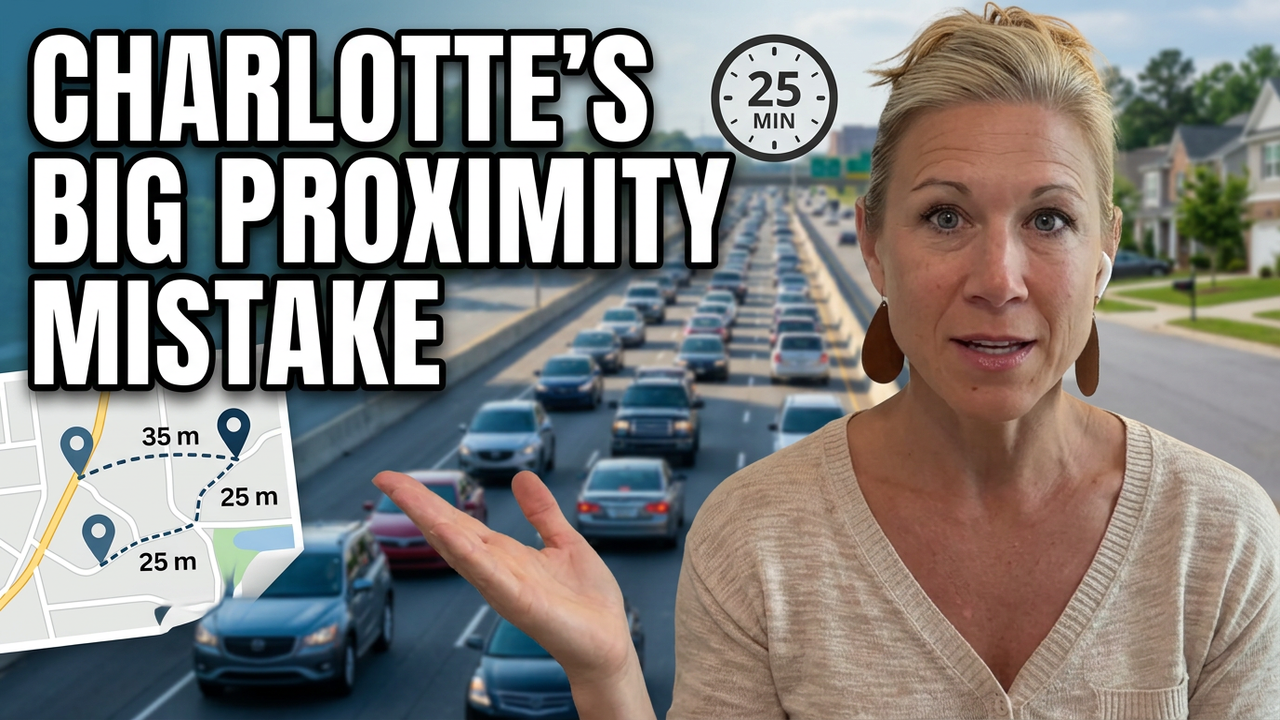
Moving to Charlotte? Here’s What “Close By” Really Means
Thinking about moving to Charlotte? Here’s what newcomers should know about commute times, traffic, walkability, shopping access, and what “close by” really means in everyday life.
One of the biggest adjustments for people relocating to Charlotte isn’t always the house itself — it’s understanding how daily life and driving work here.
Charlotte has plenty of restaurants, shopping centers, gyms, grocery stores, and entertainment, but the city is designed very differently than many newcomers expect. Things are often spread out, traffic patterns matter, and “close” doesn’t always mean five minutes away.
In the video below, we break down what daily convenience, commute times, and neighborhood accessibility really look like in the Charlotte area.
Watch the Video
Moving to Charlotte? What “Close By” Actually Means
Video Transcript
If you're planning a move to Charlotte, one of the biggest things to understand is what “close by” actually means here.
Charlotte has almost everything you need — restaurants, grocery stores, gyms, shopping, entertainment — but it’s not always located right around the corner.
Many services are built in clusters or mixed-use hubs rather than evenly spread throughout the city.
That means you’ll often drive to shopping centers or commercial areas instead of walking out your front door to nearby stores.
Another important thing to understand is the difference between Charlotte and smaller towns.
In smaller towns, there may be fewer options, but everything tends to be closer together.
In Charlotte, you’ll usually have far more choices, but they’re spread across a larger area. The trade-off becomes variety versus proximity.
Drive times are another adjustment for many people relocating here.
In Charlotte, a 15 to 25 minute drive is considered very normal — even for everyday activities like grocery shopping, going to the gym, or meeting friends for dinner.
A general rule many locals use is estimating about two minutes per mile under normal conditions, though traffic can quickly change that.
And that leads to another major factor: traffic patterns.
Distance alone doesn’t tell the full story in Charlotte.
The same drive can feel completely different depending on the time of day. Midday traffic is often manageable, while rush hour can significantly increase commute times.
That’s why it’s important to GPS common routes at different times before choosing a neighborhood.
Daily routines also tend to become more intentional here.
Instead of quickly running out for a single errand, many residents plan multiple stops together and think strategically about where they live in relation to everyday necessities.
This is one reason why location strategy matters so much when buying a home in Charlotte.
Two neighborhoods may look close on a map but function very differently in real life depending on traffic flow, road access, and commute routes.
For some buyers, being near grocery stores, gyms, veterinarians, schools, or work becomes just as important as the house itself.
Another important expectation to adjust is walkability.
In areas like Uptown Charlotte, walkability can be excellent. But in many suburban communities, “close” usually means accessible by car rather than walking distance.
Once you understand the layout, Charlotte can feel very convenient — but it’s important not to assume every area offers the same level of walkability.
There are also a few local quirks that surprise many newcomers.
Liquor in North Carolina is sold through state-controlled ABC stores rather than regular grocery stores.
The DMV and tag office are separate locations — one handles licenses while the other handles vehicle registration and plates.
And if someone says “bless your heart,” it may not always mean exactly what you think.
These are the kinds of everyday details that can make a big difference once you actually start living in Charlotte.
Thinking About Moving to Charlotte?
Relocating is about more than finding the right house — it’s about understanding how the city actually functions day to day.
If you’re considering a move to Charlotte and want help finding the right fit for your lifestyle, commute, and daily routine, our team would love to help.

Relocating to Charlotte With Kids? What Families Need to Know About Schools
Relocating to Charlotte with kids? Here’s what families should know about school zones, commute impact, private vs public schools, and choosing the right neighborhood.
When families relocate to the Charlotte area, finding the right house is only part of the decision.
For many buyers, schools become one of the biggest factors shaping where they choose to live. School zones, commute times, public versus private options, and long-term planning can all have a major impact on daily life and future satisfaction with a neighborhood.
In the video below, we walk through some of the biggest school-related factors relocating families should consider before buying a home in the Charlotte area.
Watch the Video
Relocating to Charlotte With Kids? Schools & Neighborhoods Explained
Video Transcript
When you're relocating with kids, one of the biggest decisions you'll make isn't just about the house. It's about the schools, too.
Here in the Charlotte area, school considerations can absolutely shape where families choose to buy.
First, let’s talk about school zones and boundaries.
Charlotte and the surrounding areas are served by multiple school districts, with Charlotte-Mecklenburg Schools being the largest. Districts determine which school your child attends based on your home address, and those boundaries can change over time as areas grow.
That’s why it’s important not to assume a home automatically feeds into a certain school. Even homes within the same neighborhood can sometimes be assigned to different schools depending on the exact location or development phase.
Before making an offer, it’s always important to verify the current school assignment for that specific address.
Next, let’s talk about commute and scheduling impact.
School location doesn’t just affect where your kids go during the day — it affects your entire routine.
Some families prioritize being close to school to simplify drop-offs and pickups. Others need to balance school location with work commutes into areas like Uptown Charlotte, Ballantyne, or other employment hubs.
In many cases, families choose a home specifically because it creates a more manageable daily drive between school, work, and activities.
Another major consideration is public versus private school options.
The Charlotte region offers a mix of public schools, charter schools, magnet programs, and private schools.
Public schools through Charlotte-Mecklenburg Schools serve much of the area, while charter and magnet programs may offer specialized academic tracks.
Private schools such as Charlotte Country Day School and Providence Day School are also popular among some families seeking smaller class sizes or specific educational programs.
Some families even prioritize proximity to a preferred private school over public school zoning.
Another important factor many buyers overlook is future grade progression.
A neighborhood that works well for elementary school may feed into a completely different middle or high school later on.
For buyers planning to stay long-term, understanding the full school pathway from elementary through high school can make a significant difference in long-term satisfaction.
Finally, schools can directly impact housing demand and property values.
In many parts of the Charlotte metro area, homes assigned to highly sought-after schools often attract stronger buyer demand and may sell more quickly.
For many relocating families, schools become one of the top search filters right alongside budget, neighborhood feel, and commute times.
Relocating with kids adds extra layers to the home search, but understanding school zones, commute impact, and long-term planning can help families make a more confident move.
Planning a Move to Charlotte?
If you're relocating to the Charlotte area with kids and want help understanding neighborhoods, school zones, and commute considerations, our team is here to help.
Reach out anytime — we’d be happy to guide you through the process and help you find the right fit for your family.
Mortgage Rates in 2026: Why Waiting Could Cost You More
Mortgage rates aren’t going back to 3%. Here’s why waiting to buy in 2026 could cost you more — and how to navigate today’s market.
If you’ve been waiting for mortgage rates to drop back to 3%, it may be time to reset expectations.
The market has shifted. Rates have stabilized around 6%, inventory is rising, and buyers are facing a very different landscape than just a few years ago. The question now isn’t “Will rates drop?” — it’s “Does waiting actually cost you more?”
In the video below, we break down what’s happening with mortgage rates, inventory, and affordability in 2026 — and what it means for buyers right now.
Watch the Video
Mortgage Rates 2026: Should You Wait or Buy Now?
Video Transcript
If you've been holding your breath for mortgage rates to drop back to 3%, it is time to exhale. Those rates are history.
After pandemic lows and a spike above 7%, rates are now leveling out near 6%. This stability is triggering what we call a lock-in thaw. Homeowners are starting to move again, and inventory is rising.
Regional inventory has increased by over 16%, helping break the market gridlock and creating a more active environment.
However, more inventory doesn’t automatically mean an easier buying process. With borrowing costs holding around 6%, many buyers are questioning whether to act now or wait.
The traditional strategy of waiting for lower rates now comes with a trade-off. As the “wait and see” window closes, the potential cost of waiting another year may outweigh any small drop in interest rates.
We’re transitioning from a market of scarcity to a market of choice — but that choice comes with higher baseline monthly costs.
This market is also highly localized. Your leverage depends on your specific area and the type of property you’re targeting.
One major advantage for buyers right now is time. Average days on market have extended beyond 60 days, giving buyers room to negotiate — something that didn’t exist just a couple of years ago.
In more competitive urban areas, inventory remains tight and sellers still hold more control.
In outlying areas and certain property types like condos and townhomes, inventory has increased significantly. These segments offer more balance and greater negotiating opportunities, including potential seller concessions.
At the same time, home values remain resilient. Median prices continue to rise, and in many areas, average home prices are approaching or exceeding higher thresholds.
It’s also important to understand that your monthly payment isn’t just driven by interest rates. Property taxes and escrow costs play a major role.
As home values increase, so do taxes, which are typically collected monthly as part of your payment. In some cases, reassessments can lead to unexpected increases after purchase.
While these costs add to your monthly expense, they also contribute to long-term value through community infrastructure and services.
The key takeaway is that true affordability is the combination of interest rates and local costs — not just the headline rate.
Because the market varies so much, there’s no universal “right time” to buy. Instead, it depends on your situation.
Some buyers are moving up, using equity to offset higher rates. First-time buyers are targeting more affordable property types to enter the market. Cash buyers are focusing on long-term value in competitive segments.
The biggest risk right now may be waiting too long. Inaction has a cost.
The market is no longer about chasing the lowest rate — it’s about understanding your position, evaluating local conditions, and making a strategic move.
What This Means for You
Whether you're buying your first home, upgrading, or investing, today’s market requires a different approach.
It’s not about timing the perfect rate — it’s about understanding the full picture: inventory, pricing, taxes, and your long-term goals.
If you want help breaking down what this market looks like for your specific situation, our team is here to guide you.

Why Neighborhood Matters More Than Price When Relocating
Relocating to a new city? Learn why choosing the right neighborhood matters more than price and how it impacts your daily lifestyle.
If you're relocating to a new area, it’s easy to focus on the numbers — price, square footage, and features.
But one of the most common (and costly) mistakes buyers make is underestimating the impact of the neighborhood. The reality is, your day-to-day lifestyle is shaped far more by where you live than the house itself.
In the video below, we break down why neighborhood feel matters more than most buyers realize — and how it can impact your everyday life.
Watch the Video
Why Neighborhood Matters More Than Price When Relocating
Video Transcript
One thing we see people get wrong all the time when they relocate is they focus almost entirely on price and the house itself, and they completely underestimate the impact of the neighborhood.
The truth is, the neighborhood feel will affect your day-to-day happiness far more than the price tag on the home.
You can renovate a kitchen, change flooring, or update a bathroom — but you cannot change the location or the feel of a neighborhood.
When people relocate, especially to a new city, they often browse online, find a home that looks great for the price, and feel like they’ve found a great deal. But what they haven’t experienced yet is what it actually feels like to live in that area every day.
Let’s start with something simple that shapes daily life: walkability versus drivability.
Some neighborhoods allow you to walk to restaurants, coffee shops, parks, or local stores. You might walk your dog to dinner, meet neighbors outside, or spend more time outdoors.
Other areas are more car-dependent. You may have a beautiful home with a larger lot, but every errand — coffee, groceries, dining — requires getting in the car.
Neither option is right or wrong, but it creates a very different lifestyle.
Next is the community vibe, which is something you can’t fully understand until you experience it.
Some neighborhoods feel social and connected — people are outside, kids are playing, neighbors interact, and community events are common.
Others are quieter and more private, with less day-to-day interaction. It all depends on your personality and what kind of environment you prefer.
Proximity to amenities is another major factor.
How close are you to grocery stores, restaurants, parks, fitness centers, schools, or medical services?
A home might look great online, but if it’s 25–30 minutes away from the places you visit regularly, that distance can affect your daily routine more than you expect.
Two homes at the same price point can offer completely different lifestyles depending on location. One might place you close to everything, while the other adds significant commute time to your day.
That difference impacts how much time you spend in the car, how easy your evenings feel, and how flexible your schedule can be.
This is why neighborhood feel is often underestimated.
It’s easy to compare numbers like price and square footage online, but neighborhood experience is something you have to feel in person.
How busy are the streets? Do people walk around? Are there local businesses nearby? Does it feel peaceful or active?
These are the factors that turn a house into a home.
That’s why we always encourage relocation buyers to explore neighborhoods in person — drive around, visit at different times of day, grab coffee nearby, and picture your everyday routine there.
Because at the end of the day, the house matters — but the neighborhood shapes your life.
Planning a Move?
If you're relocating and want help finding not just the right home, but the right neighborhood for your lifestyle, our team is here to guide you.
Reach out anytime — we’ll help you make a move that truly fits how you want to live.

Charlotte Housing Market 2026: Why Sales Are Down but Demand Is Rising
The Charlotte housing market in 2026 shows mixed signals — sales are down, but demand is rising. Here’s what the data really means for buyers and sellers.
If you’ve been watching the Charlotte housing market in early 2026, you may have noticed what looks like conflicting data.
On the surface, it can feel like the market is slowing down. But when you look deeper, the numbers tell a very different story — one that points to stabilization, not decline.
In the video below, we break down what’s really happening in the Charlotte market, why sales and demand appear to be moving in opposite directions, and what it means for buyers and sellers moving forward.
Watch the Video
Charlotte Housing Market 2026: Data Breakdown & What It Means
Video Transcript
During periods of economic transition, surface-level data can often project contradictory signals. In early 2026, the Charlotte housing market began producing a structural paradox.
A lagging indicator from January 2026 showed closed sales dropping by 13.7% compared to the previous year. At the same time, a leading indicator from mid-March showed the opposite trend, with pending sales rising by 15.3%.
When active contracts increase while final closings decline, it can create the illusion of falling demand. In reality, this gap often reflects a delay in the transaction pipeline rather than a true market slowdown.
The data in 2026 suggests a shift toward normalization as the market adjusts after years of volatility. Transaction activity is beginning to follow more traditional seasonal patterns, moving away from the unpredictable pace seen in the early 2020s.
One of the main drivers of this shift is the stabilization of mortgage rates, which have been ranging between 6% and 6.6%. This creates a more predictable cost of borrowing and allows both buyers and sellers to make more confident decisions.
As a result, affordability has improved slightly, enabling more buyers to re-enter the market. This has also encouraged more homeowners to list their properties, leading to a significant increase in new inventory.
New listings surged by over 50% month-over-month, representing the top of the transaction pipeline. This increase in supply helps explain the earlier divergence between closed and pending sales.
Lower closed sales in January reflected reduced contract activity from late 2025, while the increase in pending sales shows current buyer engagement in response to rising inventory.
As inventory moves through the pipeline, active listings have grown by over 16%, giving buyers more options. This has introduced more time into the transaction process.
The average time on market has increased significantly, and when factoring in financing and closing timelines, the full transaction cycle now averages over 100 days.
This added time allows buyers to conduct proper inspections and due diligence, replacing the urgency and bidding wars that defined previous years.
While overall supply levels suggest a balanced market, conditions vary depending on location. Core urban areas remain relatively tight in inventory, while outlying areas are seeing more balanced conditions and increased buyer leverage.
Property type also plays a role. Single-family homes remain competitive, while townhomes and condominiums are experiencing higher inventory levels and longer time on market.
Despite longer selling timelines, home prices have remained stable. Sellers are still receiving around 95% of their original asking price, and median home values have seen modest year-over-year growth.
This indicates that the market is adjusting through time rather than price. Homes may take longer to sell, but values are holding steady.
Overall, the Charlotte housing market in 2026 reflects a transition toward a more balanced and sustainable environment. The apparent decline in sales is largely a timing issue within the transaction pipeline, not a collapse in demand.
What This Means for Buyers and Sellers
If you're buying or selling in Charlotte, understanding how the market is shifting can help you make better decisions.
For buyers, increased inventory and longer timelines mean more opportunities to negotiate and make informed choices.
For sellers, pricing strategy and patience are key. While homes may take longer to sell, values remain stable, and well-positioned properties continue to perform.
If you want help understanding how these trends apply to your specific situation, our team is here to guide you.
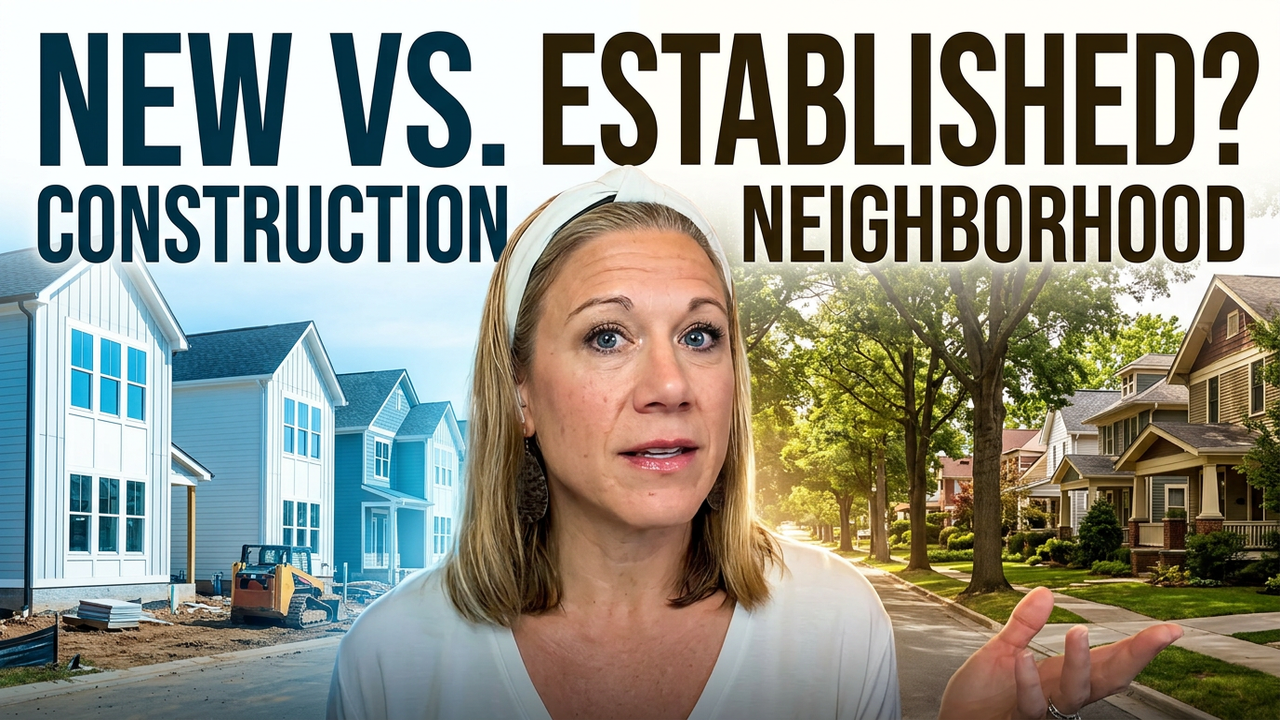
New Construction vs Established Homes in Charlotte: Which Is Right for You?
Should you buy new construction or an established home in Charlotte? Learn the key differences in lifestyle, maintenance, and resale to help you decide.
If you're thinking about buying a home in Charlotte, one of the biggest decisions you'll face is whether to choose new construction or an established neighborhood.
This decision goes far beyond the age of the home. It impacts your lifestyle, long-term maintenance, resale potential, and how you experience day-to-day living in the Queen City.
In the video below, we break down the real differences between new construction and established homes in Charlotte so you can make the right decision for your situation.
Watch the Video
Charlotte New Construction vs Established Homes: What Buyers Need to Know
Video Transcript
If you are thinking about buying a home here in Charlotte, one of the biggest decisions you are going to make is this: do you go with new construction or do you buy in an established neighborhood?
This decision is about so much more than the age of the house. It’s about your lifestyle, long-term maintenance, resale, and how you want to live every single day here in the Queen City.
Let’s start with new construction. In areas like Ballantyne, Huntersville, and Fort Mill, you’ll find many newer communities with modern floor plans, open-concept layouts, larger kitchen islands, walk-in closets, and energy-efficient features.
The biggest advantage is that everything is new — the roof, HVAC, plumbing, and electrical systems. That means you’re typically not facing major replacements anytime soon. Builder warranties can also provide added peace of mind.
Many of these communities are master-planned, offering amenities like pools, clubhouses, sidewalks, and green spaces. Overall, they tend to feel convenient, clean, and low-maintenance, especially in the early years.
However, there are trade-offs. Lot sizes are often smaller, and trees are still young, so you may not have the mature landscaping found in older neighborhoods. In some cases, you may also be living near ongoing construction as communities continue to build out.
When it comes time to resell, you could be competing with the builder if new homes are still being offered nearby.
Another important factor is property taxes. In new construction, taxes may initially be based only on the land value and then reassessed after the home is completed, which can increase your monthly payment if taxes are escrowed.
Now let’s talk about established neighborhoods. Areas like Dilworth, Myers Park, NoDa, and SouthPark offer something that can’t be replicated overnight — history, mature landscaping, architectural character, and a strong sense of place.
These neighborhoods often feature larger lots, tree-lined streets, and close proximity to restaurants, local businesses, and cultural areas. You’re typically closer to Uptown, and the community identity is already well established.
That said, older homes often require more maintenance. You may encounter aging plumbing, electrical systems that have been updated over time, or major components like roofs and HVAC systems that are partway through their lifespan.
Even beautifully renovated homes can still have older underlying systems, making inspections especially important.
When it comes to maintenance, new construction usually requires minimal upkeep during the first five to ten years. However, because everything was installed at the same time, major replacements may occur around the same period later on.
In established homes, maintenance is often more spread out. For example, the roof may have been replaced several years ago, while the HVAC or windows may have been updated more recently. This depends heavily on how well the home has been maintained.
Lifestyle is where this decision becomes more personal. If you value walkability, character, and proximity to the city’s core, established neighborhoods often stand out.
If you prefer newer homes, community amenities, and a more suburban feel, new construction communities may be a better fit.
Resale is another factor to consider. New homes tend to attract buyers because they are modern and move-in ready. However, in developing communities, timing your resale is important if builders are still selling nearby.
Established neighborhoods often hold value well because the location is proven and land is limited.
Ultimately, there’s no one-size-fits-all answer. The right choice depends on your lifestyle, maintenance preferences, long-term plans, and what feels like home to you.
The best approach is to compare not just the homes, but the lifestyles. Walk neighborhoods, visit at different times of day, and understand long-term costs beyond just the purchase price.
Thinking About Buying in Charlotte?
Whether you're deciding between new construction or an established neighborhood, having the right local insight can make all the difference.
If you’re planning a move and want help comparing your options, reach out anytime. We’re here to help you find the right fit for your lifestyle and long-term goals.

Charlotte Housing Guide 2026 | HOAs, New Builds & Where to Live
Thinking about buying a home in Charlotte? From HOA rules and new construction trends to what “updated” really means, this guide breaks down what buyers need to know before making a move in 2026.
If you're thinking about buying a home in Charlotte, it's important to understand what homes are actually like before getting emotionally attached to a listing online.
Many buyers come in with expectations shaped by other markets, only to realize that Charlotte homes follow very specific patterns — from layouts and ceiling heights to HOA rules and new construction trends. Knowing what to expect ahead of time can help you make a more confident and informed decision.
In the video below, we break down what homes in the Charlotte area are really like, including common home styles, what “updated” actually means, and how neighborhoods can vary more than you might expect.
Watch the Video
Charlotte Housing Guide 2026 | HOAs, New Builds & Where to Live
Video Transcript
If you are thinking about buying a home in the Charlotte area, we want to give you a very real picture of what homes are actually like here before you get emotionally attached to a listing online.
The truth is, Charlotte homes follow some very consistent patterns, and knowing them upfront can save you from a lot of surprises.
First, let’s talk about common home styles and layouts. A large portion of Charlotte’s housing stock was built between the late 1980s and the mid-2000s. That means you’ll see a lot of two-story traditional homes with brick fronts and vinyl siding on the sides and back.
Layouts often feel more segmented than what many buyers expect today. Formal dining rooms are extremely common, along with separate living rooms or front sitting rooms that may not get used often. Kitchens were not originally designed to be the focal point of the home, so even when a house is described as “open,” it often means a wall was partially removed rather than a fully open concept layout.
Ceiling height is another common expectation gap. Eight-foot ceilings are very normal, even at higher price points. Nine-foot ceilings downstairs are more common in newer builds, but they’re not guaranteed.
Next, let’s talk about HOAs, because this is one of the biggest adjustments for buyers moving to the Charlotte area. HOAs are very common, even in neighborhoods that don’t feel new or planned. In newer communities, they are often unavoidable.
Most HOAs cover things like common area maintenance, landscaping, and neighborhood lighting. Some include amenities like pools or clubhouses. However, they are also focused on maintaining exterior appearance, which means there may be rules around fences, paint colors, sheds, rentals, and even how long trash cans can be visible.
Fees vary widely, and higher fees don’t always mean a better neighborhood. The key thing to understand is that most HOAs are designed to maintain consistency and protect property values, not necessarily to provide luxury amenities. Enforcement can also vary depending on the HOA board and management company.
Now let’s talk about new construction. Not all new builds are created equal. Charlotte has experienced significant growth, and production builders dominate much of the new construction market.
Many homes are designed to photograph well, with features like white kitchens, gray flooring, and black fixtures. However, layouts are often very similar from one neighborhood to another. Lot sizes tend to be smaller, with homes built closer together, and square footage is often prioritized over yard space.
Townhomes are also becoming increasingly common, even in areas that were traditionally dominated by single-family homes. Many new builds are part of master-planned communities, which often include HOA involvement and may limit future customization.
Another important thing to understand is what “updated” really means in Charlotte. In most listings, “updated” typically refers to cosmetic improvements such as new flooring, fresh paint, updated light fixtures, or new countertops.
It does not necessarily mean that major systems have been replaced. It’s common to see homes with beautifully updated interiors but older roofs, HVAC systems, plumbing, or electrical components. That doesn’t make it a bad home, but it does mean buyers should look beyond the finishes and consider potential future costs.
Finally, neighborhood differences play a major role in the home buying experience. Two homes at the same price point can feel completely different depending on their location.
Urban areas like South End or Plaza Midwood tend to have older homes with more character, walkability, and unique features, but they may also come with quirks or aging infrastructure. Suburban areas like Ballantyne, Huntersville, or Fort Mill often offer newer homes, more space, and planned communities, but may involve longer commutes and more structured HOA environments.
In Charlotte, price alone doesn’t tell the full story. The age of the home, the neighborhood culture, and the HOA structure all play a significant role in what daily life actually looks like.
Before buying, it’s important to look beyond the photos and understand the structure of the home, the rules you’ll be living under, and how the neighborhood truly functions.
If you need help navigating the Charlotte market or want guidance before making a move, that’s exactly what we’re here for.
Thinking About Buying in Charlotte?
If you're planning to buy a home in the Charlotte area and want help understanding neighborhoods, HOAs, or what to look for beyond listing photos, our team is here to help.
Reach out anytime with your questions — we’re here to help you make a confident move.
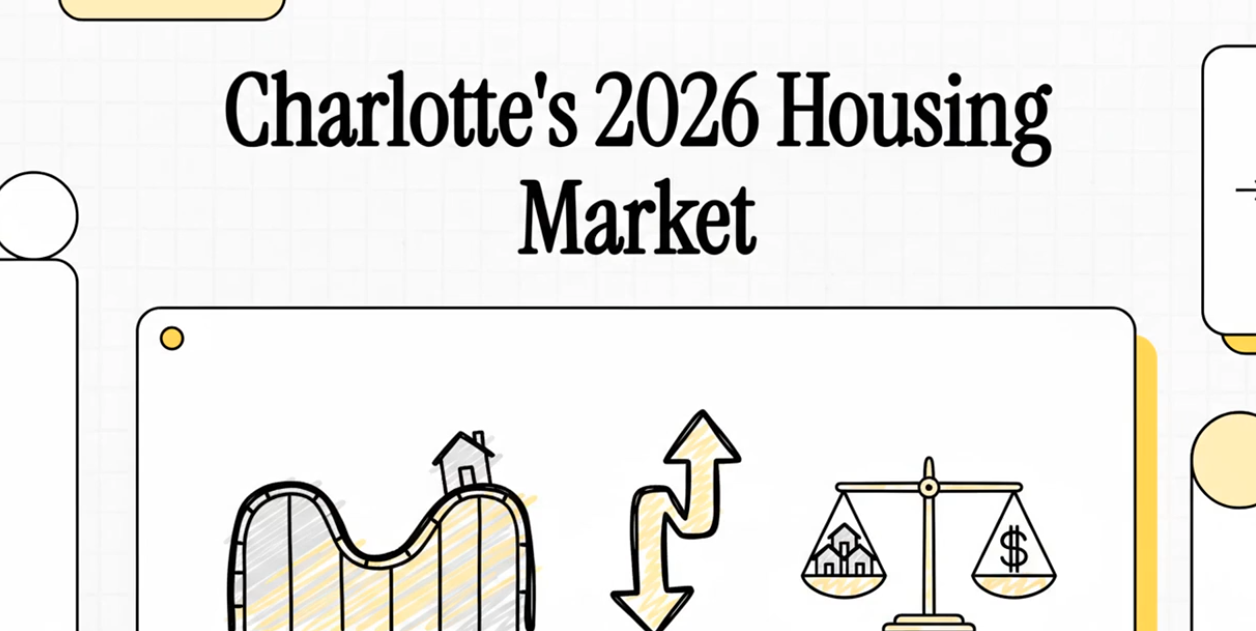
Charlotte Real Estate Market 2026: Is the Boom Over or Just Normalizing?
The Charlotte real estate market is shifting as we move through 2026. After several years of intense competition, rising inventory and changing buyer behavior are bringing the market back toward balance. In this update, we break down what’s driving the changes and what buyers, sellers, and investors should know about the Charlotte housing market moving forward.
Over the past few years, the real estate market in Charlotte has felt like a roller coaster. Rapid price increases, intense competition, and limited inventory created one of the most competitive markets many buyers and sellers had ever experienced.
But as we move through 2026, the market is beginning to shift. Instead of the extreme ups and downs of the past few years, Charlotte is entering a new phase that many experts are calling a return to balance.
In the video below, we break down what’s really happening in the Charlotte housing market, why the changes are occurring, and what buyers and sellers should understand moving forward.
What’s Happening in the Charlotte Housing Market Right Now
If you're watching the housing market in Charlotte, a few major trends are shaping the current environment.
Inventory Is Increasing
The number of homes available for sale has grown significantly over the past year. More inventory gives buyers more choices and reduces the intense competition that defined the previous market cycle.
Homes Are Staying on the Market Longer
Properties are spending more time on the market compared to the peak frenzy years. This gives buyers more time to evaluate homes and negotiate terms.
The Market Is Stabilizing
Instead of dramatic price spikes, the Charlotte market is shifting toward slower, more sustainable growth. Many experts expect modest appreciation rather than the rapid increases seen in previous years.
Charlotte’s Economy Remains Strong
Job growth and population increases continue to drive long-term housing demand in the region, helping support home values even as the market normalizes.
In the video below, we take a deeper look at what all of this means for buyers, sellers, and investors in Charlotte.
Watch the Video
Charlotte Real Estate Market Update: What’s Really Happening in 2026
Video Transcript
All right, let's get right into it. For the past few years, the Charlotte real estate market has felt like a total roller coaster. As we move through 2026, there is a major shift happening, and today we're breaking down exactly what’s going on, why it’s happening, and what it means for buyers and sellers.
This is the question that everyone is asking. Whether you're thinking about buying, selling, or simply watching the market from the sidelines, you've probably felt the change. Is the boom finally over? Is this becoming a buyer’s market?
The best way to describe what’s happening right now is something many experts are calling the great normalization. This isn’t a crash, and it’s not another boom. It’s really a return to balance. Instead of a frenzy, we’re seeing a market that’s becoming more stable and predictable.
One of the biggest shifts is the balance of power between buyers and sellers. The days of sellers naming almost any price and receiving multiple offers immediately are largely behind us.
A key piece of data illustrates this change. Over the past year, available housing inventory has increased dramatically, with nearly a 40 percent jump in the number of homes on the market. That surge in inventory is one of the biggest factors moving the market away from an extreme seller’s market and back toward equilibrium.
As inventory rises, the average amount of time homes spend on the market has also increased. Properties that once sold in around 29 days are now averaging closer to 40 days. That extra time gives buyers something they haven’t had in years: breathing room.
Instead of rushing to submit offers within hours, buyers can now take time to evaluate homes, negotiate terms, and make more thoughtful decisions.
The difference between the previous market and today’s environment is clear. During the peak frenzy, buyers often waived inspections and entered aggressive bidding wars. Today, seller concessions are returning, buyers have negotiating power again, and transactions feel more balanced.
Industry leaders view this shift not as a downturn, but as a healthy normalization. A more stable housing market tends to benefit everyone in the long run.
That brings us to the next big question: what’s happening with home prices?
While the rapid double-digit appreciation seen in previous years has slowed, prices are not crashing. Instead, the market is moving toward steady and sustainable growth.
Many housing experts expect home values to increase at a more moderate pace, typically in the range of about two to four percent annually. This reflects a healthier market where homes are viewed as long-term investments rather than short-term speculation.
One reason prices remain stable is Charlotte’s strong economy. The region continues to experience significant job growth and corporate investment.
In 2025 alone, the Charlotte metro area added more than 37,000 new jobs, representing one of the fastest growth rates among major metropolitan areas in the United States.
Job growth plays a major role in housing demand. When more people move to an area for work, they also need places to live. Charlotte continues to attract corporate relocations and expansions, particularly in sectors like financial technology and professional services.
Population growth is another major factor. On average, more than 150 new residents move to the Charlotte region every day. This steady influx of new residents helps sustain long-term demand for housing across the metro area.
Within the market, different neighborhoods continue to perform differently. Some established luxury neighborhoods are still seeing strong appreciation. Areas like Myers Park and Eastover have experienced significant long-term growth, making them attractive for buyers focused on long-term wealth preservation.
Other areas, such as Ballantyne, offer a strong combination of affordability, highly rated schools, and desirable amenities, making them appealing for families relocating to the region.
Growth is also extending beyond the city center. Charlotte’s suburbs continue to expand as buyers seek more space, strong school systems, and lifestyle amenities such as access to Lake Norman and charming historic downtown districts.
High-paying jobs are increasingly spreading throughout the region, creating multiple economic centers and supporting housing demand across both the city and surrounding communities.
So what does this all mean for buyers and sellers navigating the Charlotte market in 2026?
For buyers, the key advantage is leverage. With more inventory and less competition, buyers can negotiate on price, closing costs, and repairs. They also have more time to evaluate their options.
For sellers, strategy is more important than ever. Pricing your home correctly from the beginning and presenting the property well are essential in a market where buyers have more choices.
Overall, Charlotte’s housing market has moved beyond the post-pandemic frenzy and is settling into a more balanced and sustainable phase. With continued job growth and steady population increases, the long-term outlook for the region remains strong.
The real question now is what the next phase of growth and development will look like for Charlotte.
Thinking About Buying or Selling in Charlotte?
Whether you're planning to buy, sell, or simply trying to understand the Charlotte real estate market, having the right local insights can make a big difference.
If you have questions about neighborhoods, home values, or current market conditions in the Charlotte area, feel free to reach out. We're always happy to help you understand what’s happening in the market and how it might affect your plans.

Winter and Spring in Charlotte: What to Expect After You Move
While summer and fall get a lot of attention, winter and spring in Charlotte play a major role in how people live and maintain their homes.
Winter in Charlotte
Winters in Charlotte are considered mild, especially for people relocating from northern states.
Most winter days fall in the 40s and 50s
Snow is rare, with only occasional dustings or short-lived cold snaps
Daily life continues with little disruption
For many transplants, Charlotte’s winter feels like a noticeable quality-of-life upgrade.
Spring in Charlotte
Spring brings warmer temperatures — and a major shift in the environment.
Pollen is heavy and visible across cars, sidewalks, and porches
Allergies can affect newcomers more than expected
Rainfall increases, helping keep Charlotte green and lush
Spring is beautiful, but preparation matters if allergies are a concern.
How Weather Impacts Lifestyle and Homes
Charlotte’s climate directly affects how people live and maintain their homes.
Outdoor spaces like patios and screened porches are used frequently
Lawns and landscaping grow quickly and require regular upkeep
Humidity makes HVAC performance and moisture control especially important
Who Charlotte Weather Is Best For
Charlotte is a strong fit for people who:
Prefer mild winters
Enjoy outdoor living most of the year
Are comfortable with summer heat and seasonal pollen
Bottom Line:
Charlotte’s weather shapes daily routines, home maintenance, and lifestyle choices — not just temperatures.
For a realistic picture of daily life before you move, request our free Charlotte Relocation Guide.

Relocating to Charlotte? Understanding the Weather Before You Move
If you’re considering relocating to Charlotte, understanding the weather is essential. Charlotte’s climate is one of the biggest reasons people move here — and why many decide to stay long-term.
Charlotte offers three strong seasons and a mild fourth, without the extremes found in many other parts of the country. The weather influences daily routines, outdoor living, and even home design.

Photo Courtesy: Charlotte’s Got a Lot
Summer in Charlotte
Summer is warm and humid, especially for those new to the South.
Temperatures: Typically upper 80s to mid-90s
Humidity: Noticeable and persistent
Daily routine: Outdoor activities shift to mornings and evenings; midday errands feel hotter
Homes: Built for heat, often featuring covered patios, shade trees, pools, and lake access
People don’t stop living in summer — they adapt.

Photo Courtesy: Mace Publishing, LLC
Fall in Charlotte
Fall is widely considered one of the best times of year.
Temperatures: Cooler mornings, comfortable afternoons
Humidity: Drops significantly
Lifestyle: Patios, breweries, festivals, and neighborhood walks become everyday activities
For many people, fall is the season that makes Charlotte feel like home.
This is Part 1 of our Charlotte weather series. Part 2 covers winter, spring, and how weather affects daily life and homeownership.
If you’re thinking about relocating and want a realistic picture of living in Charlotte, request our free Charlotte Relocation Guide for insights on neighborhoods, lifestyle, and what to expect before you move.

Moving to Charlotte, NC? A Practical Guide to Relocation Planning
Relocating to Charlotte, NC requires more than choosing a home. This practical guide outlines current market conditions, common relocation challenges, and city-specific considerations to help buyers plan a smoother, more informed move.

Charlotte, North Carolina Skyline
Charlotte continues to attract relocating buyers due to economic stability, lifestyle options, and housing variety—particularly those moving from out of state or across North Carolina. Successful relocation depends on understanding both market conditions and local context.
An under construction home
Market Conditions to Know
Median home prices reflect strong demand
Inventory levels fluctuate by neighborhood
Days on market vary based on location and price point
Relocation Challenges Without Local Insight
Misjudging commute patterns across Charlotte and surrounding suburbs
Overlooking neighborhood-level pricing differences and inventory shifts
Underestimating coordination between lenders, inspectors, and closing timelines
Relocation Process (Simplified)
Plan → Coordinate → Partner → Close
City-Specific Considerations
Average utilities below national average
Multiple internet and voice provider options
Regional growth continues to influence housing demand
Local market dynamics vary significantly by neighborhood, making citywide averages less reliable for relocation decisions.
Those considering a move may benefit from reviewing the complete Charlotte relocation guide for detailed planning, neighborhood insights, and next steps.

Relocating to Charlotte, NC? Neighborhoods That Shape the Experience
Relocating to Charlotte is about more than finding a home—it’s about choosing a neighborhood that supports your daily life. From Lake Norman communities to urban districts and luxury hubs, understanding how location shapes lifestyle is key for buyers planning a move.

Downtown Charlotte, North Carolina, Skyline views
Charlotte’s relocation appeal is shaped by diverse neighborhoods offering distinct lifestyles. Grand Allure Home Group helps relocating buyers understand how location choices impact daily living.

Aerial view of Lake Norman, Charlotte, North Carolina
Mooresville
Lake Norman access and waterfront communities
Strong recreation and boating culture
Known for motorsports and NASCAR-related industries
Suburban feel with growing housing options
Cornelius
Established residential neighborhoods near the lake
Walkable pockets with dining and local shops
Easy commute into Charlotte
Appeals to buyers seeking balance between lake life and convenience
Huntersville
Access to nature preserves, protected wildlife areas, and miles of trails
Borders Lake Norman for boating and outdoor recreation
Home to Birkdale Village for shopping, dining, and entertainment
Popular for buyers wanting suburban living with amenities close by
NoDa (North Davidson)
Arts-forward district with nightlife, galleries, and live music
Adaptive reuse spaces and historic character
Light rail access to Uptown Charlotte
Appeals to buyers seeking an urban, creative environment
SouthPark
One of Charlotte’s most upscale areas
High-end dining, cocktail lounges, and boutique shopping
Large homes and luxury apartments with resort-style amenities
Central location with strong professional and corporate presence

Scenic pathway in North Carolina Park
Lifestyle & Infrastructure
Strong healthcare and employment anchors
Extensive trail systems and green spaces
Easy access to mountains, beaches, and regional travel
Relocation Framework (Snapshot)
Financing and planning
Home search and coordination
Inspections and appraisals
Closing and transition
For a side-by-side comparison of Charlotte neighborhoods and housing options, request the complete relocation guide.

Best Relocation in Charlotte, NC? What Buyers Should Know
Relocating to Charlotte involves more than picking a home—it requires planning, coordination, and local insight. From timelines and virtual showings to neighborhood fit and market timing, understanding how relocation works can make all the difference. This guide breaks down the process and explains why having a local expert matters when making a move to one of the country’s fastest-growing metros.

Charlotte, NC city skyline
Relocation to Charlotte involves more than choosing a home—it requires coordination, timing, and local insight. Grand Allure Home Group supports relocating buyers with a structured approach grounded in local market knowledge.

A woman writing a moving checklist
How Relocation Works
Initial Planning: Timelines, budget, location priorities, in-state vs out-of-state considerations
Active Coordination: Showings, virtual tours, listing prep, scheduling
Third-Party Involvement: Lenders, inspectors, title, insurance, movers
Completion & Closing: Final approvals, documentation, and move-in planning
Why Local Guidance Matters
Charlotte’s growth impacts inventory and competition
Neighborhood fit varies widely by commute, lifestyle, and housing type
Timing matters with market cycles, school calendars, and job relocations
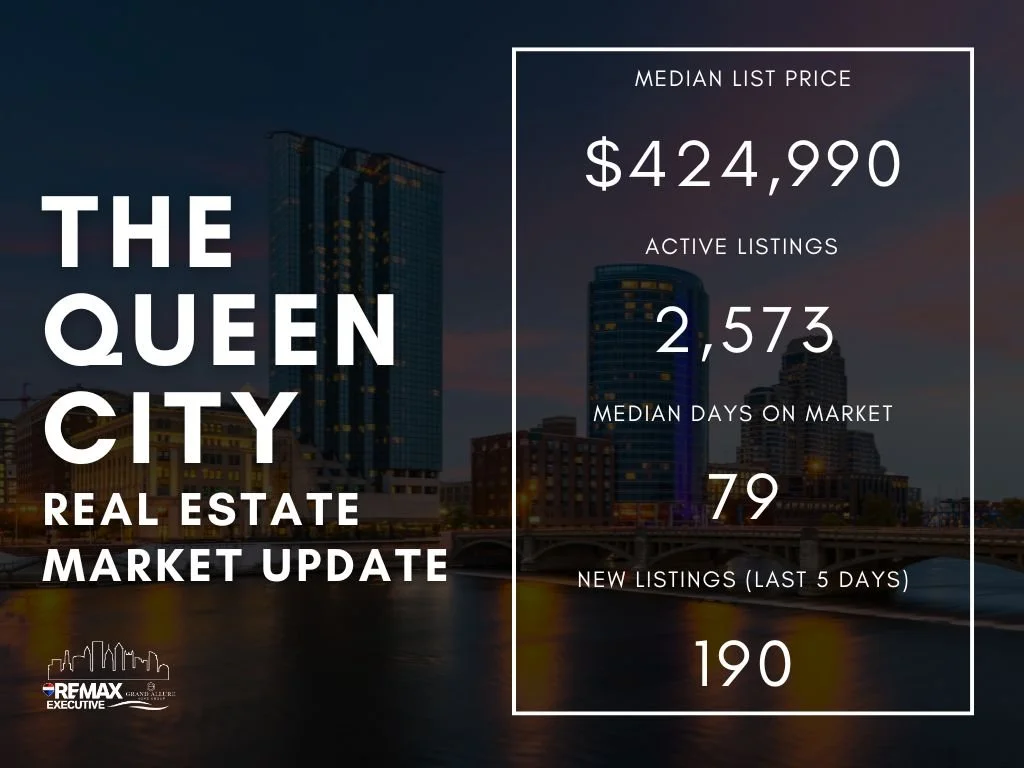
Charlotte Local Market Update as of January 12, 2026 (Source: ListReports)
Charlotte Market Insight (As Seen in Realtor.com)
Charlotte’s market is getting national attention. In Realtor.com’s article, “Top 5 Metros Where Homes Are Piling Up on the Market,” Brooke Sines of Grand Allure Home Group was quoted, with our website included as a local resource.
For relocating buyers, this highlights why local guidance matters. National trends set the stage, but neighborhood-level insight determines how those trends affect your move.
City-Specific Considerations
Mild winters and year-round mobility
Utility costs average ~$109/month
Internet & Voice: AT&T, Spectrum, Vonage
Request the full Charlotte relocation guide for a complete overview of neighborhoods, timelines, and planning considerations.